<!DOCTYPE html PUBLIC "-//W3C//DTD XHTML 1.0 Strict//EN" "DTD/xhtml1-strict.dtd"><html xml:lang="en" xmlns="http://www.w3.org/1999/xhtml">
<head>
<title>Multimedia Catalogue - Glossary - Barometer</title>
<link rel="stylesheet" href="museo.css" type="text/css"/>
<meta name="htdig-keywords" content="applsim"/>
<meta http-equiv="content-type" content="text/html; charset=UTF-8"/>
<meta http-equiv="dc:title" content="Barometer"/>
<meta http-equiv="dc:language" content="ENG"/>
<meta http-equiv="dc:subject" content=""/>
<meta http-equiv="dc:date" content=""/>
<meta http-equiv="dc:description" content=""/>
<meta http-equiv="dc:format" content=""/>
<meta http-equiv="dc:type" content="phisycal object"/>
<meta http-equiv="dc:type" content="cultural"/>
<meta http-equiv="dc:type" content="original"/>
<meta http-equiv="dc:rights" content="Istituto e Museo di Storia della Scienza, Firenze, Italia"/>
<script type="text/javascript">
function restringi(applicazione){
								document.forms[0].keywords.value=applicazione;
								this.document.forms[0].submit();
							  }
function MM_openBrWindow(theURL,winName,features) {window.open(theURL,winName,features);}
</script>
<style type="text/css">
body {
min-width: 1000px;
}
.float_left {
	float: left;
}
.float_right {
	float: right;
	width: 145px;
}
</style>
</head>
<body>
<div id="intestazione">
<div class="blocco"> </div>
<div id="logo">
<a href="http://www.museogalileo.it/en/index.html">
<img src="../elogo-museo.gif" alt="logo Museo Galileo - Institute and Museum of the History of Science" width="475" height="37" class="noborder"/>
</a>
</div>
</div>
<div id="navigazione">
<div class="blocco"></div>
<div id="quadretti"><img src="../quadretti.jpg" alt="quadretti" width="39" height="19"/></div>
<div id="lingua"><a href="isim.asp?c=200301">ITALIANO</a> / <span class="grigio">ENGLISH</span></div>
</div>
<table id="corpo" class="noborder" cellpadding="0" cellspacing="0" summary="Layout table">
<tr>
<td valign="top" class="inalto left">
<table width="100%" class="noborder" cellpadding="0" cellspacing="0">
<tr>
<td colspan="3"><table width="100%" class="noborder" cellpadding="0" cellspacing="0">
<tr>
<td colspan="3" id="cattopbar"><div class="float_left"><img src="immagini/etopbar_23258.gif" width="636" height="50" class="noborder" usemap="#Map" alt="Topbar"/>
<map name="Map" id="Map2">
<area shape="rect" coords="9,5,376,48" href="index.html" alt="Multimedia Catalogue"/>
<area shape="rect" coords="427,17,577,46" href="esim.asp?c=23258" alt="Glossary"/>
</map>
</div>
<div class="float_right"><a href="http://catalogue.museogalileo.it"><img src="ebanner_nuova_versione.jpg" alt="" class="noborder"/></a>
</div>
</td>
</tr>
</table>
</td>
</tr>
</table>
<table class="noborder" cellpadding="0" cellspacing="0">
<tr>
<td colspan="2" class="left" id="catnavbar"><a href="index.html" class="catalogobreadcrumb">Catalogue</a> <span class="navbrackets">&gt;</span> <a href="esim.asp?c=23258" class="catalogobreadcrumb">Glossary</a> <span class="navbrackets">&gt;</span></td>
</tr>
<tr>
<td valign="top" id="titolo"><a href="javascript:MM_openBrWindow('ifoto.asp?foto=http://vitruvio.imss.fi.it/foto/sim/simapprart/simapprart-200301_300.jpg','','width=350, height=350, left=20, top=20')"><img src="http://vitruvio.imss.fi.it/foto/sim/simapprart/simapprart-200301_150.jpg" alt="Imagine: Barometro" class="fotobio"/></a>
<span class="titolosala">Barometer</span><br/>
<span class="date"><b>  . . . . . . . . . . . . . . . . .</b></span>
<div class="Section1">
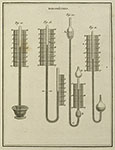
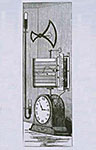
<p class="Normal-H" style="text-align:justify;text-justify:inter-ideograph;">In a famous experiment of 1644, Evangelista Torricelli (1608-1647) filled a glass tube with mercury, closed it at one end, and turned it upside down in a small basin also filled with mercury. He observed that the mercury column did not descend completely into the basin, but remained at a height of about 76 cm from the open end of the tube. Torricelli correctly identified atmospheric pressure as the cause of the phenomenon. Experiments later performed across Europe established that the level of the mercury column varied with the changes in atmospheric pressure at different altitudes. This led to the development of a new instrument&#8212;the barometer&#8212;which was soon used for weather forecasting. Later models were built in different shapes and sizes. Many design changes made the instrument more sensitive, simpler to read, and easily transportable. In the nineteenth century, the barometer became a very popular instrument for "telling the weather" in middle-class homes and public places. By c. 1850, the aneroid barometer&#8212;compact, rugged, and easy to carry&#8212;had became an international fixture.</p>
</div>
</td>
</tr>
<tr>
<td> </td>
</tr>
<tr>
<td>
<span class="subtitolo">
<a href="javascript:MM_openBrWindow('ifoto.asp?foto=http://vitruvio.imss.fi.it/foto/sim/simapprart/simapprart-200302_300.jpg','','width=350, height=350, left=20, top=20')">
<img src="http://vitruvio.imss.fi.it/foto/sim/simapprart/simapprart-200302_150.jpg" alt="" class="fotobio"/>
</a>
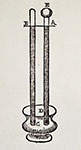
<a name="200302" class="bordeaux2 grassetto">Basin barometer</a>
</span>
<span class="date"></span>
<div class="Section2">
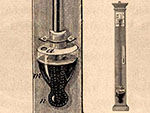
<p class="Normal-H" style="text-align:justify;text-justify:inter-ideograph;">Instrument directly derived from the Torricellian experiment. The lower end of the barometric tube stands in a basin filled with mercury. The changes in the mercury level corresponding to the variations in atmospheric pressure are read on the tube.</p>
</div>
<p> </p>
<p> </p>
</td>
</tr>
<tr>
<td>
<span class="subtitolo">
<a href="javascript:MM_openBrWindow('ifoto.asp?foto=http://vitruvio.imss.fi.it/foto/sim/simapprart/simapprart-200303_300.jpg','','width=350, height=350, left=20, top=20')">
<img src="http://vitruvio.imss.fi.it/foto/sim/simapprart/simapprart-200303_150.jpg" alt="" class="fotobio"/>
</a>
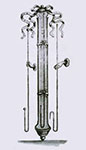
<a name="200303" class="bordeaux2 grassetto">Siphon barometer</a>
</span>
<span class="date"></span>
<div class="Section3">
<p class="Normal-H" style="text-align:justify;text-justify:inter-ideograph;">In this type of barometer, atmospheric-pressure variations are recorded through changes in the level of mercury in a U tube (siphon), whose shorter arm is open.</p>
</div>
<p> </p>
<p> </p>
</td>
</tr>
<tr>
<td>
<span class="subtitolo">
<a href="javascript:MM_openBrWindow('ifoto.asp?foto=http://vitruvio.imss.fi.it/foto/sim/simapprart/simapprart-200304_300.jpg','','width=350, height=350, left=20, top=20')">
<img src="http://vitruvio.imss.fi.it/foto/sim/simapprart/simapprart-200304_150.jpg" alt="" class="fotobio"/>
</a>
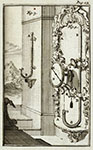
<a name="200304" class="bordeaux2 grassetto">Wheel barometer</a>
</span>
<span class="date"></span>
<div class="Section4">
<p class="Normal-H" style="text-align:justify;text-justify:inter-ideograph;">A special type of siphon barometer invented by the English scientist Robert Hooke (1635-1702) c. 1664. Thanks to a system of floats and pulleys, the changes in mercury level are translated into the movements of a pointer on a dial.</p>
</div>
<p> </p>
<p> </p>
</td>
</tr>
<tr>
<td>
<span class="subtitolo">
<a href="javascript:MM_openBrWindow('ifoto.asp?foto=http://vitruvio.imss.fi.it/foto/sim/simapprart/simapprart-200305_300.jpg','','width=350, height=350, left=20, top=20')">
<img src="http://vitruvio.imss.fi.it/foto/sim/simapprart/simapprart-200305_150.jpg" alt="" class="fotobio"/>
</a>
<a name="200305" class="bordeaux2 grassetto">Cistern barometer</a>
</span>
<span class="date"></span>
<div class="Section5">
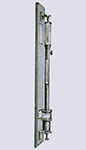
<p class="Normal-H" style="text-align:justify;text-justify:inter-ideograph;">In this model, the barometric tube, containing mercury, stands in a vessel also filled with mercury, whose bottom consists of a leather membrane. By changing the position of the membrane, the mercury can be made to rise in the tube until it is completely filled. This prevents sudden movements of the mercury, thus making the instrument easier to transport.</p>
</div>
<p> </p>
<p> </p>
</td>
</tr>
<tr>
<td>
<span class="subtitolo">
<a href="javascript:MM_openBrWindow('ifoto.asp?foto=http://vitruvio.imss.fi.it/foto/sim/simapprart/simapprart-200306_300.jpg','','width=350, height=350, left=20, top=20')">
<img src="http://vitruvio.imss.fi.it/foto/sim/simapprart/simapprart-200306_150.jpg" alt="" class="fotobio"/>
</a>
<a name="200306" class="bordeaux2 grassetto">Fortin barometer</a>
</span>
<span class="date"></span>
<div class="Section6">
<p class="Normal-H" style="text-align:justify;text-justify:inter-ideograph;">This portable model was developed by the French scientific-instrument maker Nicolas Fortin (1750-1831). The cistern is partly made of glass; the bottom is made of leather. A screw is used to compress the leather and calibrate the barometer by adjusting the lower mercury level to coincide with a reference mark.</p>
</div>
<p> </p>
<p> </p>
</td>
</tr>
<tr>
<td>
<span class="subtitolo">
<a href="javascript:MM_openBrWindow('ifoto.asp?foto=http://vitruvio.imss.fi.it/foto/sim/simapprart/simapprart-200307_300.jpg','','width=350, height=350, left=20, top=20')">
<img src="http://vitruvio.imss.fi.it/foto/sim/simapprart/simapprart-200307_150.jpg" alt="" class="fotobio"/>
</a>
<a name="200307" class="bordeaux2 grassetto">Multiple folded barometer</a>
</span>
<span class="date"></span>
<div class="Section7">
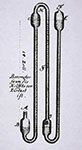
<p class="Normal-H" style="text-align:justify;text-justify:inter-ideograph;">Barometer whose tube displays several bends or "folds"; the vertical arms are filled alternately with mercury and a liquid serving both as a level indicator and a medium for transmitting the mercury's movements. Folded barometers are shorter and more manageable than standard mercury versions, but less precise. First described by Guillaume Amontons (1663-1705) in 1688.</p>
</div>
<p> </p>
<p> </p>
</td>
</tr>
<tr>
<td>
<span class="subtitolo">
<a name="200308" class="bordeaux2 grassetto">Stereometric barometer</a>
</span>
<span class="date"></span>
<div class="Section8">
<p class="Normal-H" style="text-align:justify;text-justify:inter-ideograph;">Model invented by Marsilio Landriani (1751-1815), who gave it the name "stereometric barometer." Thanks to a tap, the mercury in the cistern can be made to flow into a graduated and calibrated tube, where its quantity can be measured.</p>
</div>
<p> </p>
<p> </p>
</td>
</tr>
<tr>
<td>
<span class="subtitolo">
<a href="javascript:MM_openBrWindow('ifoto.asp?foto=http://vitruvio.imss.fi.it/foto/sim/simapprart/simapprart-200309_300.jpg','','width=350, height=350, left=20, top=20')">
<img src="http://vitruvio.imss.fi.it/foto/sim/simapprart/simapprart-200309_150.jpg" alt="" class="fotobio"/>
</a>
<a name="200309" class="bordeaux2 grassetto">Balance barometer</a>
</span>
<span class="date"></span>
<div class="Section9">
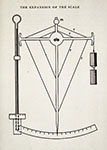
<p class="Normal-H" style="text-align:justify;text-justify:inter-ideograph;">Model in which the barometric tube (or the cistern) is suspended from the arm of a balance. The atmospheric pressure is therefore calculated not from the mercury's level, but from its weight in the tube (or the cistern).</p>
</div>
<p> </p>
<p> </p>
</td>
</tr>
<tr>
<td>
<span class="subtitolo">
<a href="javascript:MM_openBrWindow('ifoto.asp?foto=http://vitruvio.imss.fi.it/foto/sim/simapprart/simapprart-200310_300.jpg','','width=350, height=350, left=20, top=20')">
<img src="http://vitruvio.imss.fi.it/foto/sim/simapprart/simapprart-200310_150.jpg" alt="" class="fotobio"/>
</a>
<a name="200310" class="bordeaux2 grassetto">Aneroid barometer</a>
</span>
<span class="date"></span>
<div class="Section10">
<p class="Normal-H" style="text-align:justify;text-justify:inter-ideograph;">Instrument basically consisting of a metal capsule in which a partial vacuum is produced. The capsule expands or contracts with the changes in pressure; its movements are transmitted to a pointer by mechanical means. Although similar designs had been developed previously, the classical aneroid barometer was perfected by the Frenchman Lucien Vidie (1805-1866) in the 1840s.</p>
</div>
<p> </p>
<p> </p>
</td>
</tr>
<tr>
<td>
<span class="subtitolo">
<a href="javascript:MM_openBrWindow('ifoto.asp?foto=http://vitruvio.imss.fi.it/foto/sim/simapprart/simapprart-200311_300.jpg','','width=350, height=350, left=20, top=20')">
<img src="http://vitruvio.imss.fi.it/foto/sim/simapprart/simapprart-200311_150.jpg" alt="" class="fotobio"/>
</a>
<a name="200311" class="bordeaux2 grassetto">Recording barometer</a>
</span>
<span class="date"></span>
<div class="Section11">
<p class="Normal-H" style="text-align:justify;text-justify:inter-ideograph;">Instruments that record changes in atmospheric pressure over time (on a ribbon or paper roll moved by a clockwork mechanism) are called "recording" or "self-registering." Many recording barometers are aneroid.</p>
</div>
<p> </p>
<p> </p>
</td>
</tr>
<tr>
<td valign="top"><div class="grigio center"><strong>.................................</strong></div></td>
</tr>
<tr>
<td valign="top"> </td>
</tr>
<tr>
<td class="center inalto"><div class="clear"> </div></td>
</tr>
<tr>
<td valign="top"> </td>
</tr>
</table></td>
<td id="correlati" rowspan="3">
<h2>EXPLORE...</h2>
<div class="left">
<h3>related objects</h3>
</div><ul><li>
<img src="immagini/icona-strumento.gif" alt=""/> 
					<a href="esim.asp?c=410001">X.1 Pillar barometer (Inv. 1136)</a>
</li>
<li>
<img src="immagini/icona-strumento.gif" alt=""/> 
					<a href="esim.asp?c=410002">X.2 Pillar barometer (Inv. 1135)</a>
</li>
<li>
<img src="immagini/icona-strumento.gif" alt=""/> 
					<a href="esim.asp?c=410003">X.3 Siphon barometer (Inv. 1142)</a>
</li>
<li>
<img src="immagini/icona-strumento.gif" alt=""/> 
					<a href="esim.asp?c=410004">X.4 Siphon barometer (Inv. 3627)</a>
</li>
<li>
<img src="immagini/icona-strumento.gif" alt=""/> 
					<a href="esim.asp?c=410005">X.5 Siphon barometer (Inv. 1141)</a>
</li>
<li>
<img src="immagini/icona-strumento.gif" alt=""/> 
					<a href="esim.asp?c=410006">X.6 Wheel barometer (Inv. 1140)</a>
</li>
<li>
<img src="immagini/icona-strumento.gif" alt=""/> 
					<a href="esim.asp?c=410007">X.7 Wheel barometer (Inv. 1139)</a>
</li>
<li>
<img src="immagini/icona-strumento.gif" alt=""/> 
					<a href="esim.asp?c=410008">X.8 Multiple folded barometer (Inv. 2006)</a>
</li>
<li>
<img src="immagini/icona-strumento.gif" alt=""/> 
					<a href="esim.asp?c=410009">X.9 Double barometer (Inv. 1155)</a>
</li>
<li>
<img src="immagini/icona-strumento.gif" alt=""/> 
					<a href="esim.asp?c=410010">X.10 De Luc barometer (Inv. 1150)</a>
</li>
<li>
<img src="immagini/icona-strumento.gif" alt=""/> 
					<a href="esim.asp?c=410011">X.11 De Luc barometer (Inv. 1556)</a>
</li>
<li>
<img src="immagini/icona-strumento.gif" alt=""/> 
					<a href="esim.asp?c=410012">X.12 Cistern barometer (Inv. 1147)</a>
</li>
<li>
<img src="immagini/icona-strumento.gif" alt=""/> 
					<a href="esim.asp?c=410013">X.13 Cistern barometer (Inv. 3707)</a>
</li>
<li>
<img src="immagini/icona-strumento.gif" alt=""/> 
					<a href="esim.asp?c=410014">X.14 Stereometric barometer (Inv. 1137)</a>
</li>
<li>
<img src="immagini/icona-strumento.gif" alt=""/> 
					<a href="esim.asp?c=410015">X.15 Barometer (Inv. 1134)</a>
</li>
<li>
<img src="immagini/icona-strumento.gif" alt=""/> 
					<a href="esim.asp?c=410016">X.16 Stick barometer (Inv. 697)</a>
</li>
<li>
<img src="immagini/icona-strumento.gif" alt=""/> 
					<a href="esim.asp?c=410017">X.17 Registering barometer (Inv. 1163)</a>
</li>
<li>
<img src="immagini/icona-strumento.gif" alt=""/> 
					<a href="esim.asp?c=410018">X.18 Fortin barometer (Inv. 3462)</a>
</li>
<li>
<img src="immagini/icona-strumento.gif" alt=""/> 
					<a href="esim.asp?c=410019">X.19 Siphon and cistern barometer (Inv. 1132)</a>
</li>
<li>
<img src="immagini/icona-strumento.gif" alt=""/> 
					<a href="esim.asp?c=410020">X.20 Portable barometer (Inv. 1149)</a>
</li>
<li>
<img src="immagini/icona-strumento.gif" alt=""/> 
					<a href="esim.asp?c=410021">X.21 Portable barometer (Inv. 1131)</a>
</li>
<li>
<img src="immagini/icona-strumento.gif" alt=""/> 
					<a href="esim.asp?c=410022">X.22 Portable barometer (Inv. 1146)</a>
</li>
<li>
<img src="immagini/icona-strumento.gif" alt=""/> 
					<a href="esim.asp?c=410023">X.23 Siphon barometer (Inv. 1144)</a>
</li>
<li>
<img src="immagini/icona-strumento.gif" alt=""/> 
					<a href="esim.asp?c=410024">X.24 Cistern barometer (Inv. 1148)</a>
</li>
<li>
<img src="immagini/icona-strumento.gif" alt=""/> 
					<a href="esim.asp?c=410025">X.25 Cistern barometer (Inv. 1161)</a>
</li>
<li>
<img src="immagini/icona-strumento.gif" alt=""/> 
					<a href="esim.asp?c=410026">X.26 Cistern barometer (Inv. 1151)</a>
</li>
<li>
<img src="immagini/icona-strumento.gif" alt=""/> 
					<a href="esim.asp?c=410027">X.27 Marine barometer (Inv. 1138)</a>
</li>
<li>
<img src="immagini/icona-strumento.gif" alt=""/> 
					<a href="esim.asp?c=410028">X.28 Barometer (Inv. 1153)</a>
</li>
<li>
<img src="immagini/icona-strumento.gif" alt=""/> 
					<a href="esim.asp?c=410029">X.29 Pocket aneroid barometer (Inv. 3659)</a>
</li>
<li>
<img src="immagini/icona-strumento.gif" alt=""/> 
					<a href="esim.asp?c=410064">X.64 Cecchi balance barometer (Inv. 3816)</a>
</li></ul></td>
</tr>
</table>
<div id="piedipagina">
<div class="blocco">        <span class="grigio">© 1995-2010 IMSS</span>  <span class="grigio">Piazza dei Giudici 1</span>  <span class="grigio">50122 Florence</span>    <span class="grigio">ITALY</span>
</div>
</div>
<noscript>
<p class="grassetto">Javascript is required for the simple search to function correctly in this page.</p>
<p class="grassetto">If Javascript is disabled please use the following links to enlarge pictures:</p>
<p><a href="http://vitruvio.imss.fi.it/foto/sim/simapprart/simapprart-200302_300.jpg" class="breadcrumb">PHOTO 1</a><br/>
<a href="http://vitruvio.imss.fi.it/foto/sim/simapprart/simapprart-200303_300.jpg" class="breadcrumb">PHOTO 2</a><br/>
<a href="http://vitruvio.imss.fi.it/foto/sim/simapprart/simapprart-200304_300.jpg" class="breadcrumb">PHOTO 3</a><br/>
<a href="http://vitruvio.imss.fi.it/foto/sim/simapprart/simapprart-200305_300.jpg" class="breadcrumb">PHOTO 4</a><br/>
<a href="http://vitruvio.imss.fi.it/foto/sim/simapprart/simapprart-200301_300.jpg" class="breadcrumb">PHOTO 5</a><br/>
<a href="http://vitruvio.imss.fi.it/foto/sim/simapprart/simapprart-200306_300.jpg" class="breadcrumb">PHOTO 6</a><br/>
<a href="http://vitruvio.imss.fi.it/foto/sim/simapprart/simapprart-200307_300.jpg" class="breadcrumb">PHOTO 7</a><br/>
<a href="http://vitruvio.imss.fi.it/foto/sim/simapprart/simapprart-200309_300.jpg" class="breadcrumb">PHOTO 8</a><br/>
<a href="http://vitruvio.imss.fi.it/foto/sim/simapprart/simapprart-200310_300.jpg" class="breadcrumb">PHOTO 9</a><br/>
<a href="http://vitruvio.imss.fi.it/foto/sim/simapprart/simapprart-200311_300.jpg" class="breadcrumb">PHOTO 10</a><br/>
</p></noscript>
<script src="http://www.google-analytics.com/urchin.js" type="text/javascript">
</script>
<script type="text/javascript">
_uacct = "UA-1978002-4";
urchinTracker();
</script>
</body>
</html>