<!DOCTYPE html PUBLIC "-//W3C//DTD XHTML 1.0 Strict//EN" "DTD/xhtml1-strict.dtd"><html xml:lang="en" xmlns="http://www.w3.org/1999/xhtml">
<head>
<title>Multimedia Catalogue - Glossary - Electrical machine</title>
<link rel="stylesheet" href="museo.css" type="text/css"/>
<meta name="htdig-keywords" content="applsim"/>
<meta http-equiv="content-type" content="text/html; charset=UTF-8"/>
<meta http-equiv="dc:title" content="Electrical machine"/>
<meta http-equiv="dc:language" content="ENG"/>
<meta http-equiv="dc:subject" content=""/>
<meta http-equiv="dc:date" content=""/>
<meta http-equiv="dc:description" content=""/>
<meta http-equiv="dc:format" content=""/>
<meta http-equiv="dc:type" content="phisycal object"/>
<meta http-equiv="dc:type" content="cultural"/>
<meta http-equiv="dc:type" content="original"/>
<meta http-equiv="dc:rights" content="Istituto e Museo di Storia della Scienza, Firenze, Italia"/>
<script type="text/javascript">
function restringi(applicazione){
								document.forms[0].keywords.value=applicazione;
								this.document.forms[0].submit();
							  }
function MM_openBrWindow(theURL,winName,features) {window.open(theURL,winName,features);}
</script>
<style type="text/css">
body {
min-width: 1000px;
}
.float_left {
	float: left;
}
.float_right {
	float: right;
	width: 145px;
}
</style>
</head>
<body>
<div id="intestazione">
<div class="blocco"> </div>
<div id="logo">
<a href="http://www.museogalileo.it/en/index.html">
<img src="../elogo-museo.gif" alt="logo Museo Galileo - Institute and Museum of the History of Science" width="475" height="37" class="noborder"/>
</a>
</div>
</div>
<div id="navigazione">
<div class="blocco"></div>
<div id="quadretti"><img src="../quadretti.jpg" alt="quadretti" width="39" height="19"/></div>
<div id="lingua"><a href="isim.asp?c=202301">ITALIANO</a> / <span class="grigio">ENGLISH</span></div>
</div>
<table id="corpo" class="noborder" cellpadding="0" cellspacing="0" summary="Layout table">
<tr>
<td valign="top" class="inalto left">
<table width="100%" class="noborder" cellpadding="0" cellspacing="0">
<tr>
<td colspan="3"><table width="100%" class="noborder" cellpadding="0" cellspacing="0">
<tr>
<td colspan="3" id="cattopbar"><div class="float_left"><img src="immagini/etopbar_23258.gif" width="636" height="50" class="noborder" usemap="#Map" alt="Topbar"/>
<map name="Map" id="Map2">
<area shape="rect" coords="9,5,376,48" href="index.html" alt="Multimedia Catalogue"/>
<area shape="rect" coords="427,17,577,46" href="esim.asp?c=23258" alt="Glossary"/>
</map>
</div>
<div class="float_right"><a href="http://catalogue.museogalileo.it"><img src="ebanner_nuova_versione.jpg" alt="" class="noborder"/></a>
</div>
</td>
</tr>
</table>
</td>
</tr>
</table>
<table class="noborder" cellpadding="0" cellspacing="0">
<tr>
<td colspan="2" class="left" id="catnavbar"><a href="index.html" class="catalogobreadcrumb">Catalogue</a> <span class="navbrackets">&gt;</span> <a href="esim.asp?c=23258" class="catalogobreadcrumb">Glossary</a> <span class="navbrackets">&gt;</span></td>
</tr>
<tr>
<td valign="top" id="titolo"><a href="javascript:MM_openBrWindow('ifoto.asp?foto=http://vitruvio.imss.fi.it/foto/sim/simapprart/simapprart-202301_300.jpg','','width=350, height=350, left=20, top=20')"><img src="http://vitruvio.imss.fi.it/foto/sim/simapprart/simapprart-202301_150.jpg" alt="Imagine: Macchina elettrostatica" class="fotobio"/></a>
<span class="titolosala">Electrical machine</span><br/>
<span class="date"><b>  . . . . . . . . . . . . . . . . .</b></span>
<div class="Section1">
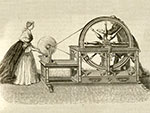
<p class="Normal-H" style="text-align:justify;text-justify:inter-ideograph;">Electrical machines, invented in the eighteenth century, are instruments for generating static electricity. Electrostatic generators were among the most important instruments in scientific laboratories of the eighteenth and nineteenth centuries. They are classified into frictional electrical machines and induction electrical machines depending on the electrification process employed.</p>
</div>
</td>
</tr>
<tr>
<td> </td>
</tr>
<tr>
<td>
<span class="subtitolo">
<a name="202302" class="bordeaux2 grassetto">Frictional electrical machine</a>
</span>
<span class="date"></span>
<div class="Section2">
<p class="Normal-H" style="text-align:justify;text-justify:inter-ideograph;">Frictional machines rely on the fact that some insulating substances such as glass, sulfur, and resin become electrically charged when rubbed vigorously. In 1660, Otto von Guericke (1602-1686) used a sulfur ball that attracted light bodies after being electrified. This provided him with an illustration of his theories on forces acting in the universe. The first true electrical machine was built c. 1700 by Francis Hauksbee (1660-1713): a glass globe (that could be evacuated) rotated rapidly by a pulley and rubbed with the hand became electrified, allowing various observations on electrostatic attraction and repulsion and on electrical discharges in a vacuum. In the following decades, and especially after the invention of the Leyden jar in 1745, countless models of electrostatic machines were developed, in which glass globes, cylinders, and disks were rotated rapidly by pulley-and-handle systems. To rub them and thus electrify them, padded leather cushions were introduced as efficient substitutes for the experimenter's hand. The charges generated were stored on large insulated metal conductors.</p>
<p class="Normal-H" style="text-align:justify;text-justify:inter-ideograph;">Toward 1750, the vogue for electrical experiments made the electrical machine an essential instrument in all scientific laboratories and collections, often used for therapeutic purposes. Specimens of different sizes were built. The largest, commissioned by the Dutch scientist Martinus van Marum (1750-1837), had two coaxial disks 165 cm in diameter operated by two men turning handles. The machine was capable of producing charges of hundreds of thousands of volts, generating sparks over 60 cm long. The smaller, portable machines were generally used for the controversial therapeutic applications of electricity.</p>
</div>
<p> </p>
<p> </p>
</td>
</tr>
<tr>
<td>
<span class="subtitolo">
<a name="202303" class="bordeaux2 grassetto">Induction machine</a>
</span>
<span class="date"></span>
<div class="Section3">
<p class="Normal-H" style="text-align:justify;text-justify:inter-ideograph;">In 1775, the Italian physicist Alessandro Volta (1745-1827) invented the electrophorus, a simple but ingenious instrument that provided an almost unlimited series of electrical discharges. From it derived the first induction electrical machines, which generated electricity not by rubbing but by a complex set of electrostatic inductions. This category includes "doublers" or "multipliers" developed in the late eighteenth century and used to "multiply" charges too weak to be measured. In c. 1830, the physicist Giuseppe Belli (1791-1860) designed the first rotating-disk induction machine, but it was only in the second half of the nineteenth century that this type of generator almost entirely replaced the old frictional machines&#8212;thanks to physicists such as Wilhelm Holtz (1836-1913), August Toepler (1836-1912), and James Wimshurst (1832-1903). From the early twentieth century on, induction electrical machines were used extensively to generate electrical discharges, to charge condensers, to power X-ray tubes, and for electrotherapy. The introduction of more efficient systems, such as transformers, to produce high-voltage currents led to the abandonment of induction machines, which are now of purely historical and educational interest. But there is an exception: in the late 1920s, the physicist Robert Van de Graaff (1901-1967) invented a ribbon electrostatic generator for producing the very high voltages needed in the emerging science of atomic and nuclear physics. Today, this type of machine, with substantial improvements, is widely used in research laboratories and for industrial applications.</p>
</div>
<p> </p>
<p> </p>
</td>
</tr>
<tr>
<td valign="top"><div class="grigio center"><strong>.................................</strong></div></td>
</tr>
<tr>
<td valign="top"> </td>
</tr>
<tr>
<td class="center inalto"><div class="clear"> </div></td>
</tr>
<tr>
<td valign="top"> </td>
</tr>
</table></td>
<td id="correlati" rowspan="3">
<h2>EXPLORE...</h2>
<div class="left">
<h3>related objects</h3>
</div><ul><li>
<img src="immagini/icona-strumento.gif" alt=""/> 
					<a href="esim.asp?c=414010">XIV.10 Globe electrical machine, Nollet type (Inv. 1341, 1342, 2737)</a>
</li>
<li>
<img src="immagini/icona-strumento.gif" alt=""/> 
					<a href="esim.asp?c=414011">XIV.11 Nairne cylinder electrical machine (Inv. 2736)</a>
</li>
<li>
<img src="immagini/icona-strumento.gif" alt=""/> 
					<a href="esim.asp?c=414012">XIV.12 Cylinder electrical machine (Inv. 2739)</a>
</li>
<li>
<img src="immagini/icona-strumento.gif" alt=""/> 
					<a href="esim.asp?c=414015">XIV.15 Plate electrical machine (Inv. 2705)</a>
</li>
<li>
<img src="immagini/icona-strumento.gif" alt=""/> 
					<a href="esim.asp?c=414016">XIV.16 Plate electrical machine (Dep. LV, Torino)</a>
</li>
<li>
<img src="immagini/icona-strumento.gif" alt=""/> 
					<a href="esim.asp?c=414017">XIV.17 Drum electrical machine (Inv. 3408)</a>
</li>
<li>
<img src="immagini/icona-strumento.gif" alt=""/> 
					<a href="esim.asp?c=414018">XIV.18 Winter plate electrical machine (Inv. 1526)</a>
</li>
<li>
<img src="immagini/icona-strumento.gif" alt=""/> 
					<a href="esim.asp?c=414019">XIV.19 Portable globe electrical machine (Inv. 444)</a>
</li>
<li>
<img src="immagini/icona-strumento.gif" alt=""/> 
					<a href="esim.asp?c=414020">XIV.20 Portable globe electrical machine (Inv. 516)</a>
</li>
<li>
<img src="immagini/icona-strumento.gif" alt=""/> 
					<a href="esim.asp?c=414021">XIV.21 Cylinder electrical machine (Inv. 392)</a>
</li>
<li>
<img src="immagini/icona-strumento.gif" alt=""/> 
					<a href="esim.asp?c=414022">XIV.22 Portable plate electrical machine (Inv. 2688)</a>
</li>
<li>
<img src="immagini/icona-strumento.gif" alt=""/> 
					<a href="esim.asp?c=414023">XIV.23 Portable plate electrical machine (Inv. 2687)</a>
</li>
<li>
<img src="immagini/icona-strumento.gif" alt=""/> 
					<a href="esim.asp?c=414024">XIV.24 Portable plate electrical machine (Inv. 2689)</a>
</li>
<li>
<img src="immagini/icona-strumento.gif" alt=""/> 
					<a href="esim.asp?c=414025">XIV.25 Portable plate electrical machine (Inv. 2686)</a>
</li>
<li>
<img src="immagini/icona-strumento.gif" alt=""/> 
					<a href="esim.asp?c=414026">XIV.26 Portable plate electrical machine (Inv. 374)</a>
</li>
<li>
<img src="immagini/icona-strumento.gif" alt=""/> 
					<a href="esim.asp?c=414027">XIV.27 Plate electrical machine (Inv. 3766)</a>
</li>
<li>
<img src="immagini/icona-strumento.gif" alt=""/> 
					<a href="esim.asp?c=414028">XIV.28 Long-spark plate electrical machine (Inv. 3711)</a>
</li>
<li>
<img src="immagini/icona-strumento.gif" alt=""/> 
					<a href="esim.asp?c=414030">XIV.30 Kundt and Cantoni electrical machine (Inv. 507)</a>
</li>
<li>
<img src="immagini/icona-strumento.gif" alt=""/> 
					<a href="esim.asp?c=414031">XIV.31 Carré electrical machine</a>
</li>
<li>
<img src="immagini/icona-strumento.gif" alt=""/> 
					<a href="esim.asp?c=414032">XIV.32 Cecchi electrical machine (Inv. 3407)</a>
</li>
<li>
<img src="immagini/icona-strumento.gif" alt=""/> 
					<a href="esim.asp?c=414033">XIV.33 Modified Carré electrical machine (Dep. LV, Torino)</a>
</li>
<li>
<img src="immagini/icona-strumento.gif" alt=""/> 
					<a href="esim.asp?c=414034">XIV.34 Wimshurst electrical machine (Inv. 3774)</a>
</li>
<li>
<img src="immagini/icona-strumento.gif" alt=""/> 
					<a href="esim.asp?c=414037">XIV.37 Henley quadrant electrometer (Inv. 1199)</a>
</li>
<li>
<img src="immagini/icona-strumento.gif" alt=""/> 
					<a href="esim.asp?c=414038">XIV.38 Henley quadrant electrometer (Inv. 1198)</a>
</li>
<li>
<img src="immagini/icona-strumento.gif" alt=""/> 
					<a href="esim.asp?c=414039">XIV.39 Henley quadrant electrometer (Inv. 483)</a>
</li>
<li>
<img src="immagini/icona-strumento.gif" alt=""/> 
					<a href="esim.asp?c=414046">XIV.46 Lane electrometer (Inv. 543)</a>
</li>
<li>
<img src="immagini/icona-strumento.gif" alt=""/> 
					<a href="esim.asp?c=414059">XIV.59 Tube Leyden-jar (Inv. 2742)</a>
</li>
<li>
<img src="immagini/icona-strumento.gif" alt=""/> 
					<a href="esim.asp?c=414061">XIV.61 Luminous discharge tubes (Inv. 850, 851, 852)</a>
</li>
<li>
<img src="immagini/icona-strumento.gif" alt=""/> 
					<a href="esim.asp?c=414063">XIV.63 Small cup for inflaming spirits (Inv. 466)</a>
</li>
<li>
<img src="immagini/icona-strumento.gif" alt=""/> 
					<a href="esim.asp?c=414072">XIV.72 Faraday's net (Inv. 387)</a>
</li>
<li>
<img src="immagini/icona-strumento.gif" alt=""/> 
					<a href="esim.asp?c=414079">XIV.79 Nobili's static-electricity galvanometer (Inv. 372)</a>
</li>
<li>
<img src="immagini/icona-strumento.gif" alt=""/> 
					<a href="esim.asp?c=414092">XIV.92 Nobili's sparking magnet (Inv. 1270)</a>
</li></ul></td>
</tr>
</table>
<div id="piedipagina">
<div class="blocco">        <span class="grigio">© 1995-2010 IMSS</span>  <span class="grigio">Piazza dei Giudici 1</span>  <span class="grigio">50122 Florence</span>    <span class="grigio">ITALY</span>
</div>
</div>
<noscript>
<p class="grassetto">Javascript is required for the simple search to function correctly in this page.</p>
<p class="grassetto">If Javascript is disabled please use the following links to enlarge pictures:</p>
<p><a href="http://vitruvio.imss.fi.it/foto/sim/simapprart/simapprart-202301_300.jpg" class="breadcrumb">PHOTO 1</a><br/>
</p></noscript>
<script src="http://www.google-analytics.com/urchin.js" type="text/javascript">
</script>
<script type="text/javascript">
_uacct = "UA-1978002-4";
urchinTracker();
</script>
</body>
</html>