<!DOCTYPE html PUBLIC "-//W3C//DTD XHTML 1.0 Transitional//EN" "http://www.w3.org/TR/xhtml1/DTD/xhtml1-transitional.dtd"><html xml:lang="it">
<head>
<META http-equiv="Content-Type" content="text/html; charset=ISO-8859-1">
<title>IL TELESCOPIO DI GALILEO - GALILEO GALILEI (attr.), Telescope, Padua or Florence, c. 1610</title>
<meta http-equiv="Content-Type" content="text/html; charset=iso-8859-1">
<meta name="generator" content="HAPedit 3.0">
<link href="telescopio.css" rel="stylesheet" type="text/css">
<style type="text/css">
body {
	font-family:Verdana, Arial, Helvetica, sans-serif;
	text-align:center;
	margin:0px 0px 0px 0px;
	background-color: #EAEEEC;
	padding:0px 0px 0px 0px;
	width:100%;
	min-width:600px;
}
</style>
</head>
<body>
<div class="sfondoInterno">
<div id="testata2"><a href="index.html" target="_blank"><img src="immagini_testata/etestata_r2_c1.jpg" width="484" height="50"></a></div>
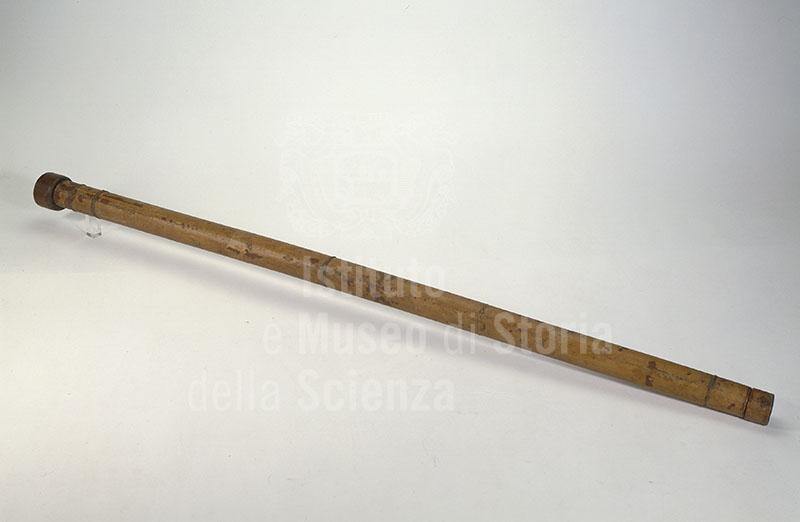
<div class="DescrizioneBig"><p>GALILEO GALILEI (attr.), <i>Telescope</i>, Padua or Florence, c. 1610<br/>Glass, wood, paper, copper<br/>Istituto e Museo di Storia della Scienza, inv. 2427<br/><br/>The second of Galileo's telescopes that has come down to us shows what the instruments actually used in observations looked like. The tube, formed of two wooden shells, is covered in paper and held together by copper rings.</p></div>
<div class="Immagine"><td><img src="http://vitruvio.imss.fi.it/foto/telescopiogalileo/2_2_7_800.jpg" alt="GALILEO GALILEI (attr.), Telescope, Padua or Florence, c. 1610"></td>
</div>
</div><script type="text/javascript">
var gaJsHost = (("https:" == document.location.protocol) ? "https://ssl." : "http://www.");
document.write(unescape("%3Cscript src='" + gaJsHost + "google-analytics.com/ga.js' type='text/javascript'%3E%3C/script%3E"));
</script><script type="text/javascript">
var pageTracker = _gat._getTracker("UA-1978002-1");
pageTracker._trackPageview();
</script></body>
</html>