<!DOCTYPE html PUBLIC "-//W3C//DTD XHTML 1.0 Transitional//EN" "http://www.w3.org/TR/xhtml1/DTD/xhtml1-transitional.dtd"><html xml:lang="it">
<head>
<META http-equiv="Content-Type" content="text/html; charset=ISO-8859-1">
<title>IL TELESCOPIO DI GALILEO - GALILEO GALILEI, Sidereus nuncius, Venice, 1610</title>
<meta http-equiv="Content-Type" content="text/html; charset=iso-8859-1">
<meta name="generator" content="HAPedit 3.0">
<link href="telescopio.css" rel="stylesheet" type="text/css">
<style type="text/css">
body {
	font-family:Verdana, Arial, Helvetica, sans-serif;
	text-align:center;
	margin:0px 0px 0px 0px;
	background-color: #EAEEEC;
	padding:0px 0px 0px 0px;
	width:100%;
	min-width:600px;
}
</style>
</head>
<body>
<div class="sfondoInterno">
<div id="testata2"><a href="index.html" target="_blank"><img src="immagini_testata/etestata_r2_c1.jpg" width="484" height="50"></a></div>
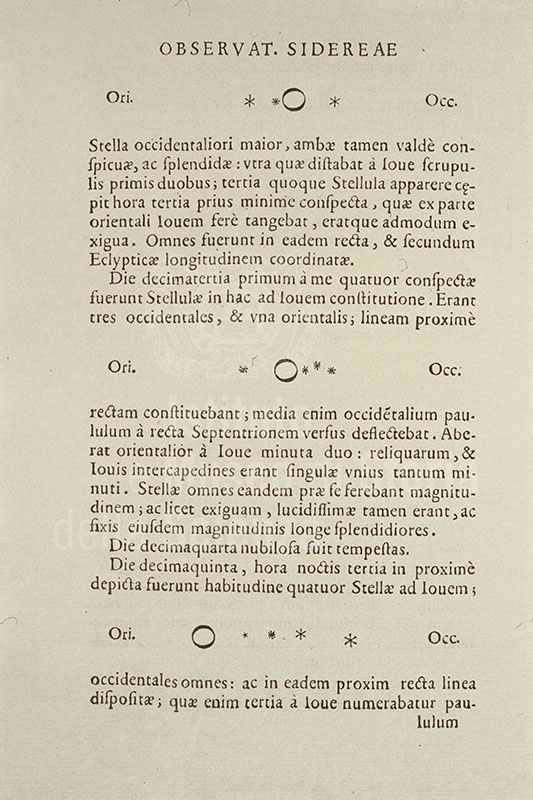
<div class="DescrizioneBig"><p>GALILEO GALILEI, <i>Sidereus nuncius</i>, Venice, 1610<br/>Biblioteca Nazionale Centrale di Firenze, Pal. 1200/23<br/>Facsimile<br/><br/>Galileo describes the discovery of Jupiter's satellites, starting from that night of 7 January 1610, when he saw beside the planet three little stars arranged in a straight line. The fourth satellite appeared through his telescope only on the night of 13 January.</p></div>
<div class="Immagine"><td><img src="http://vitruvio.imss.fi.it/foto/telescopiogalileo/2_3_7_800.jpg" alt="GALILEO GALILEI, Sidereus nuncius, Venice, 1610"></td>
</div>
</div><script type="text/javascript">
var gaJsHost = (("https:" == document.location.protocol) ? "https://ssl." : "http://www.");
document.write(unescape("%3Cscript src='" + gaJsHost + "google-analytics.com/ga.js' type='text/javascript'%3E%3C/script%3E"));
</script><script type="text/javascript">
var pageTracker = _gat._getTracker("UA-1978002-1");
pageTracker._trackPageview();
</script></body>
</html>