<!DOCTYPE html PUBLIC "-//W3C//DTD XHTML 1.0 Transitional//EN"><html xml:lang="it">
<head>
<META http-equiv="Content-Type" content="text/html; charset=ISO-8859-1">
<title>Vitrum: Glass between Art and Science in the Roman World</title>
<link rel="stylesheet" href="vitrum.css" type="text/css">
<meta http-equiv="Content-Type" content="text/html; charset=iso-8859-1">
<meta http-equiv="description" content="Vitrum: Glass between Art and Science in the Roman World">
<meta meta="htdig-keywords" content="applvit">
<meta http-equiv="dc:language" content="ENG">
<meta http-equiv="dc:rights" content="Istituto e Museo di Storia della Scienza, Firenze, Italia"><script>
function restringi(indirizzo){
								document.cerca.keywords.value=indirizzo;
								this.document.cerca.submit();
							  }
</script><style type="text/css">
</style><script language="JavaScript" type="text/JavaScript"></script></head>
<body>
<div id="intestazione">
<div class="blocco"></div>
<div id="logo"><a href="http://www.museogalileo.it/en/index.html"><img src="../elogo-espo.gif" alt="Institute and Museum of History of Science" width="475" height="37" border="0"></a></div>
</div>
<div id="navigazione">
<div class="blocco"></div>
<div id="quadretti"><img src="../quadretti.jpg" alt="quadretti" width="39" height="19" align="left"></div>
<div id="lingua3"><a href="ivtr.asp?c=8552&amp;k=8408&amp;rif=8408">ITALIAN0</a> / <span class="grigio">ENGLISH</span> / <a href="fvtr.asp?c=8552&amp;k=8408&amp;rif=8408">FRANÇAIS</a></div>
</div>
<table width="97%" border="0" cellpadding="0" cellspacing="0" id="corpo" summary="Layout table">
<tr>
<td align="left" class="inalto">
<table width="100%" border="0" align="left" cellpadding="0" cellspacing="0" bgcolor="#FFFFFF" summary="Layout table">
<tr>
<td colspan="3" valign="bottom" id="orientamento">  </td>
</tr>
<tr>
<td colspan="3" valign="bottom" background="immagini/back1.gif"> </td>
</tr>
<tr>
<td width="28%" align="center" valign="top">
<p><img src="immagini/home_eng-top.gif" alt="Vitrum. Art and Science in roman glass" width="260" height="280"></p>
<p><span class="style17"><a href="http://www.cite-sciences.fr/english/indexFLASH.htm" target="_blank"><img src="immagini/cite-50.gif" alt="Cité des Sciences" width="49" height="50" hspace="5" border="0" align="left"></a>From January 31 to August 27, 2006, the exhibition will be on display at the Cité des Sciences in Paris, France. </span></p></td><script>document.write('<td width="40%" id="testo">')</script><span class="titoli-verre">Vitrum: Glass between Art and Science in the Roman World</span><p><campo tipocampo="T" nome="txtxml" style=""><div class="Section1" xmlns:w="http://schemas.microsoft.com/office/word/2003/wordml" xmlns:o="urn:schemas-microsoft-com:office:office" xmlns:v="urn:schemas-microsoft-com:vml" xmlns:WX="http://schemas.microsoft.com/office/word/2003/auxHint" xmlns:aml="http://schemas.microsoft.com/aml/2001/core" xmlns:w10="urn:schemas-microsoft-com:office:word">
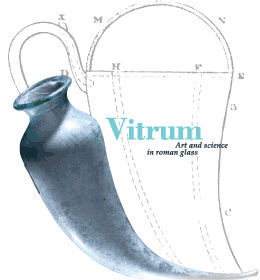
<p class="Normal-P" style="text-align:justify;text-justify:inter-ideograph;"><span class="Normal-H">Archaeological findings and literary sources of the I century A.D. document a considerable production and use of glass objects in Vesuvian cities and numerous other centres of the <st1:place w:st="on" xmlns:st1="urn:schemas-microsoft-com:office:smarttags">Roman Empire</st1:place>. Today in many museums, we can observe the extraordinary quantity and variety of these artefacts, usually exhibited to arouse admiration for their shape, colour and decoration. The striking, progressive diffusion of glass objects, in reality, derived from a profound technological innovation tied to experimental investigations and, in several cases, to a theoretical discussion on the material's composition and its scientific functionality. The technique of glass-blowing and the attention that ancient philosophers devoted to explaining the ultimate composition of the material, favoured an extraordinary encounter between art and science, between the craftsman's manual dexterity and the philosopher's intellectual achievement. </span></p>
<p class="Normal-P" style="text-align:justify;text-justify:inter-ideograph;"><span class="Normal-H">Indeed, glass objects were not made exclusively for commodity or to appeal to the prevailing aesthetic taste: the ancients in reality conceived of glass as an ideal material for the progress of knowledge. For this reason, the exhibition itinerary seeks to evidence how these cities were inhabited by men capable of working glass into apparatuses and devices which profoundly contributed to increasing the scientific and technological knowledge of antiquity and laid the basis for the &#8220;scientific&#8221; rediscovery of this material in the Renaissance. </span></p>
<p class="Normal-P" style="text-align:justify;text-justify:inter-ideograph;"><span class="Normal-H">In more general terms, Roman glass was a preferred source of inspiration in solving several fundamental theoretical problems, which led scientific curiosity onto till-then unexplored territories.</span></p>
</div></campo></p><script>document.write('</td>')</script><td width="30%" valign="top"><div align="left">
<p><br><strong><span class="style15"><font color="#00CCCC">|</font></span> 	<span class="grassetto style15">Vitrum</span><br><br><span class="style15"><font color="#00CCCC">|</font></span><span class="grassetto style16 style15"> 	
	 <a href="evtr.asp?c=8552&amp;k=8448&amp;rif=8448" class="breadcrumb">Information</a></span><br><br><span class="style15"><font color="#CC503B">|</font></span><span class="grassetto style16 style15"> 	
	 <a href="evtr.asp?c=8552&amp;k=8168&amp;rif=8168" class="breadcrumb">Exhibition</a></span><br><br><span class="style15"><font color="#CC503B">|</font></span><span class="grassetto style16 style15"> 	
	 <a href="evtr.asp?c=8552&amp;k=8407&amp;rif=8407" class="breadcrumb">Models</a></span><br><br><span class="style15"><font color="#00CCCC">|</font></span><span class="grassetto style16 style15"> 	
	 <a href="evtr.asp?c=8552&amp;k=8451&amp;rif=8451" class="breadcrumb">Digital Library</a></span><br><br><span class="style15"><font color="#00CCCC">|</font></span><span class="grassetto style16 style15"> 	
	 <a href="evtr.asp?c=8552&amp;k=8449&amp;rif=8449" class="breadcrumb">Credits</a></span><br><br><span class="style15"><font color="#00CCCC">|</font></span><span class="grassetto style16 style15"> 	
	 <a href="evtr.asp?c=8552&amp;k=8450&amp;rif=8450" class="breadcrumb">Links</a></span><br><br></strong></p>
</div></td>
</tr>
<tr>
<td colspan="3" background="immagini/back2.gif"><p> </p>
</td>
</tr>
<tr>
<td align="left">  </td>
<td align="left"> </td>
</tr>
</table>
</td>
</tr>
</table>
<div id="piedipagina">
<div class="blocco">        <span class="grigio">© 2005 IMSS</span>  <span class="grigio">Piazza dei Giudici 1</span>  <span class="grigio">50122 Florence</span>    <span class="grigio">ITALY</span></div>
</div><script type="text/javascript">
var gaJsHost = (("https:" == document.location.protocol) ? "https://ssl." : "http://www.");
document.write(unescape("%3Cscript src='" + gaJsHost + "google-analytics.com/ga.js' type='text/javascript'%3E%3C/script%3E"));
</script><script type="text/javascript">
var pageTracker = _gat._getTracker("UA-1978002-1");
pageTracker._trackPageview();
</script></body>
</html>