
EXPLORE...
Chronology
Biographies
Functioning

Instruments > Astronomy
Jovilabe
Inventor: Galileo Galilei - Maker: unknown
Second half 17th C.
Brass
400x195 mm
IMSS, Current inventory: 3178
Brass
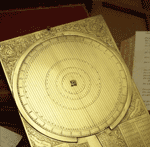
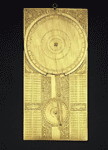
instrument, undated and of unknown maker. The Jovilabe is certainly connected
to Galileo's efforts to determine the periods of Jupiter's moons - whose
discovery he announced in 1610 in Sidereus
Nuncius [Starry Messenger]
(Venice, 1610) - and to compute the times of their eclipses. Galileo
immediately realized that eclipses of Jupiter's moons could provide a precise
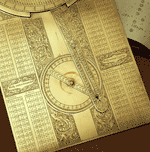
method to determine the longitude. The instrument is engraved with tables
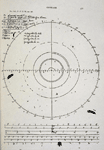
showing the mean motions of each of the four moons. Two connected disks of
different diameters are rotated by means of a movable rod. They are used to
create a "view from the Sun" of the movements of Jupiter's moons
observed from the Earth (movements that seem irregular because of the
heliocentric motions of the Earth and Jupiter). Galileo began the systematic
study of the periods of Jupiter's moons in 1611, developing a micrometer for
the purpose. The Pisan scientist compiled tables of the periods that he
offered, with his telescopes, first to the King of Spain (1611, 1612, 1616, and
1627-1628), then to the States General of Holland (1637-1641). To convince his
Spanish interlocutors that Jupiter and its moons could be observed on unstable
ground, such as a ship's deck, Galileo designed a special helmet carrying a
small telescope on a hinged mount. The device was named celatone (celata = "helmet" in Italian). In this second
proposal, he also described the advantages of applying the pendulum to the
clock. Despite the interest they aroused, neither of his proposals was
accepted. Provenance: estate of Leopold de' Medici.