



Leonardo da Vinci photo gallery


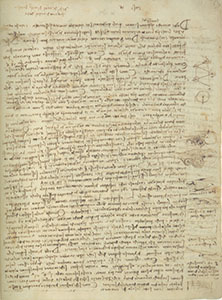
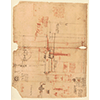
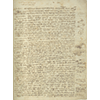
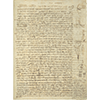
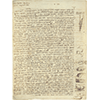
Codex Leicester, 13r. - Page with nine figures and eighteen propositions ("16 cases" pertaining to river currents, navigation, and the tides, with a memorandum added at the top on two books, the "De navi" by Leon Battista Alberti and the "De acqujdotti" (i.e., the "De aquis urbis Romae") by Sextus Julius Frontino. A system for facilitating the deviation of rivers is inspired by a method used in Flanders, reported to Leonardo da Niccolò by Forzore Spinelli (a goldsmith). The observations on the Arno, described in the figures, refer to the Florentine section of the river delineated by the Ponte Rubaconte (today's Ponte alle Grazie), Palazzo Bisticci and Palazzo Canigiani, the "della Giustizia" weir and the island of the Cocomeri "in the middle of the Arno".
Alessandro Vezzosi
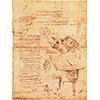
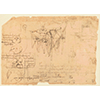
![Codex Atlanticus, 918r. - Study for a map of Tuscany (and adjacent areas), c. 1502. Hydrography in pencil, place names in pen and ink on paper. Codex Atlanticus, f. 910r. Surroundings of Castiglion Fiorentino (Aretino): "Montanina / Mammi / Chasstiglione aretino / a / b / c / to c is 1000 braccia / Cilone / road / Vingone / Renello / Monterchio / road [today SS 71] / road / road / 1380 braccia / 2024 braccia / Rucano / Chiane / road / 2208 braccia / 1472 braccia / 1704 braccia / f. Renello / f. Renello / 1104 braccia / road / the high 16 braccia / 1288 braccia / 650 braccia / Lock / [S]anto Antonio / Lake", c. 1502.](https://vitruvio.imss.fi.it/foto/isd/av/ca_0918r_100q.gif)
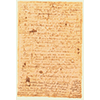
![Codex Atlanticus, 952r. - Study for the lake of San Lorenzo in Arniano near Vinci, c. 1504. The properties owned by "Giovanni Betti, Lazzero del Volpe, the Commune, and Ser Piero [Leonardo's father]" are indicated.](https://vitruvio.imss.fi.it/foto/isd/av/ca_0952r_100q.gif)
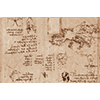
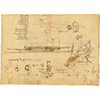
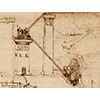
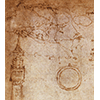
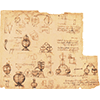
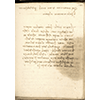
![Codex Leicester, 6v. - "Of ebb and flow" is the title of this page, which deals especially with the phenomenon of the tides. The folio concludes with a note on the diverse nature of the stone materials, progressively reduced in size, that, entrained downstream from the mountains, end up on the seabed: originally rocks, then pebbles and sand, and lastly "clay to make jugs with" (cf. ff. 6A - 31v e 18A - 19v). Writes Leonardo: "The river (Vin) [Vincio pistoiese? Cf. Madrid II, f. 23r], that flows down from the mountains, brings a great quantity of large stones in its riverbed, which stones still have some sharp corners and edges; and as it flows on, the stones it brings are smaller with the edges more consumed, that is, the big stones become smaller; and further on, it deposits large pebbles, and then smaller ones ..."](https://vitruvio.imss.fi.it/foto/isd/av/lei_06v_100q.gif)
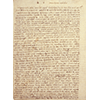
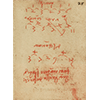
![Codex Leicester, 9v. - Page with two drawings, which is dedicated, as stated already in the premise, to confuting the theories on fossil shells hypothesising that they had been transported far from the sea by the Biblical Flood Among his personal recollections, Leonardo mentions a "great sack" of fossil shells and corrals collected on the mountains around Parma and Piacenza by some peasants who had brought them to his "factory" where he was working on the "great Horse" for the Sforza. And then the timber found at Castelfiorentino ("in my time", that is, in his youth). In the margin of the folio he adds two experiments conducted in a "hole" with plates of glass at the sides: that of the deep wave and the wind [fig. 1]; and that of the surface wave. Interesting is the memorandum on making a terracotta shower: "Have it made here at the jug-maker".](https://vitruvio.imss.fi.it/foto/isd/av/lei_09v_100q.gif)
Last update 14/mar/2008