



Leonardo da Vinci photo gallery


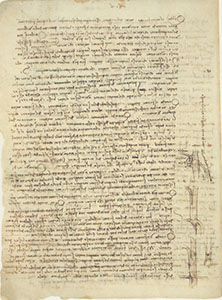
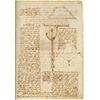
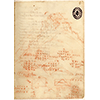
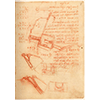
Codex Leicester, 18v. - Page with four drawings and sixteen "cases" on the confluence of two rivers and the relevant effects. Leonardo considers the numerous variables that could occur in the combination of larger and smaller watercourses, of different orientation. The most precise and best documented is the one regarding the Arno, where the Mensola torrent flows into it (cf. the beautiful drawing RLW 12679). The Mensola is flowing at high water, its mouth is obstructed by stones and debris that the water leaps over, falling beyond and digging out the riverbed; and then pushes on the material it has excavated, creating three "cliffs"; as long as the Arno is at low water it cannot break them down... Three figures show an acute angle of confluence; two minor watercourses that augment the course of the major one; the dominant force of the current of the big river over that of a torrent intersecting it. Writes Leonardo: "Concavity made by Mensola, when Arno is low and Mensola big".
Alessandro Vezzosi
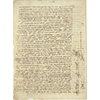
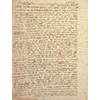
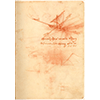
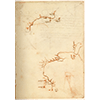
![Codex Leicester, 32v. - Page without figures, containing observations on watercourses and on physical geography. On the lower part of the sheet Leonardo discusses subjects pertaining to the presence of water on mountains, which is not drawn there by the heat of the sun. The earth does not act "like a sponge"; it is not true that the water in the sea, far from the shore, is as high as the mountains. Writes Leonardo: "The water found in the highest mountains is not there because it was drawn up by the sun, because little of such heat arrives there, as can be seen below La Vernia, the force of the sun being insufficient to melt the ice in the greatest heat of summer; on the contrary, the ice remains stored in the caverns where it was placed at the end of winter [...]".](https://vitruvio.imss.fi.it/foto/isd/av/lei_32v_100q.gif)
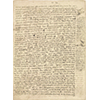
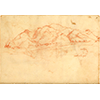
![Codex Leicester, 34v. - "There are two centres of sphericity of water: one is that of universal water, the other is particular. Of the universal kind is that which serves for all of the waters without motion, which make up a great quantity, such as canals, ditches, fish nurseries, springs, wells, dead rivers, lakes, swamps and seas; the which, although they are all of different heights, have surfaces that are equidistant from the centre of the world, as in the lakes found at the tops of the highest mountains, like the one on Pietra Pana, and the lake of the Sibilla, a Norcia[...]". The mountain of "Pietra Pana", mentioned also by Dante, is Pania della Croce, in the Alpi Apuane; it has an altitude of 1,858 meters above sea level. Today there is a mountain shelter, the Rifugio Pietra Pana, at an altitude of 1,180 m.](https://vitruvio.imss.fi.it/foto/isd/av/lei_34v_100q.gif)
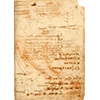
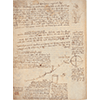
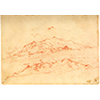
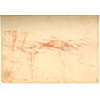
![Madrid Ms. II, 1v. - Notes on the surroundings of Pisa ("Level of the Arno taken on the day of the Magdalene [July 22] 1503") and notes on work at Piombino, c. 1503-1504.](https://vitruvio.imss.fi.it/foto/isd/av/madii_001v_100q.gif)
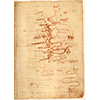
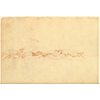
![Madrid Ms. II, 3r. - Measurements made between Montalbano, the Monti Pisani and Volterra and mention of "Francesco da Siena", c. 1503. In the long list of books "In cases at the monastery", he mentions also a "Book on abacus, Giovan del Sodo has it" and a "Cornazano de re militari, Gug[li]lelmo de' Pazi has it".](https://vitruvio.imss.fi.it/foto/isd/av/madii_003r_100q.gif)
Last update 14/mar/2008